There has been lots going on over the past few months; many
comings and goings. To save time I thought I’d sit down and just write briefly about them all at once, with lots of pictures.
In July I WENT on
vacation.
I don’t go on vacation often; there aren’t many places to go
when you are a single young lady with no travel buddy. True, the Peace Corps
Volunteers always find ways to travel around, but their stories generally start
with “one day I was hitch-hiking…” However, in the first week of July I had my
chance. A fellow Canadian MCC worker was driving down south through Mozambique
with her Mozambican colleague, and I met them on the highway near Machanga. Getting
to the highway was an adventure in itself. I had to bike 40 mins to town with
all my bags, leave my bike at my friend’s house, walk 30 mins to the river,
cross in a tiny dug-out canoe, walk again to the town on the other side, wait
an hour in the open bed of a pick-up truck “bus” for it to leave, and suffer
the hour long bumpy ride to the main highway squeezed between two strangers.
But I met my friends no problem and had a lovely couple days on the beach.
 |
| On one of mozambique's beautiful southern beaches in Inhambane province. It was still winter, hence the sweater, but we went for a swim nonetheless! |
 |
| The crossing to Mambone as I leave Machanga. Imagine this same boat with 5-6 passengers... thankfully the river is shallow an it is possible to walk most of the way in case the boat capsizes. |
Grace CAME to visit
me!
After the beach, my friend and I bused even further south,
crossed into South Africa, and picked up my little sister from OR Tambo
International Airport in Johannesburg. She traveled all the way to South Africa
on her own to come visit me! Braver than I was at 16. We toured around Kruger
National Park for a couple days. She couldn’t come all the way here and not see
the animals! Also, it was a good excuse for me to get in some excellent
birding.
 |
| Saddle-billed storks. Aren't those the craziest looking birds? |
 |
| Southern Yellow-billed hornbill. Credit for the bird pictures goes to Grace Standen. |
 |
| Go Pirates, Go! Grace, my friend Natasha and I were invited to a soccer game by a South African woman we met in a taxi. The three of us were the only white people in the ENTIRE stadium, but the atmosphere was incredible. |
Grace and I CAME to
Machanga
Grace and I then came
back to Machanga together. Having people visit is so special. First of all,
it gets lonely here. You can tell people all you want about Canada, about your
family at home, but they feel so far away. With Grace I laughed more in a day
than I do in two weeks by myself. Having a visitor also lets me see things
through new eyes; Mozambican culture, my work, language, food, goats. It is refreshing
and encouraging. And finally, there is now
someone at home who has a better idea of Mozambique, what my life is like here,
and the work MCC does.
 |
| Grace and I hanging out on the beach in Beira, Mozambique. |
 |
| Grace at my home in Machanga learning how to grate coconut and killing it. |
 |
| We spent a lot of time during her week or so in Machanga going around visiting my students. Here she is with Isabel Armando in her vegetable garden. It was fun to show off my little sister to all my friends here. Also funny that many couldn't tell who was older because Grace is much taller than me. |
Grace WENT home and I
WENT to the USA
Sadly, Grace went at
the end of July, and on the same day I also went to the States to MCC US’s headquarters in Akron, PA. I attended
MCC’s leadership seminar. Why was I sent to attend an MCC leadership seminar,
you ask? Well, let me tell you. I’ve landed a new position with MCC starting in
January 2016. I will be co-facilitator of MCC’s Seed Program in Southern
Africa. MCC has a number of young adult exchange programs, and if you haven’t
heard of Seed yet, you will hopefully hear more of it in the future. It started
in Colombia several years ago, then Bolivia, and next year there are two new
programs starting; one in the DRC and one in Southern Africa. Basically, it
sprung from the idea that one year exchanges are not long enough, and there
needs to be purposeful learning and reflection for the experience to be
meaningful to the individual, and meaningful to MCC’s partners and program as a
whole. In January I will go to
Zimbabwe where I will co-facilitate the program in Southern Africa. The
participants will come from all 6 countries where MCC works in Southern Africa
(Mozambique, Zimbabwe, Zambia, Swaziland, Lesotho, and South Africa) and one or
two participants from North America. They will be working with MCC partners for
two years in those same 6 countries (though not the country where they are
originally from). All of the work will be focused existing conservation
agriculture projects. They will also participate in extensive orientation,
learning, and reflection sessions. This program combines four things I love
most: learning, leadership development, agriculture, and MCC!
Also, I WENT to
Colombia
As a part of my preparation for this new position, I and the
other new facilitators went to Colombia to visit the existing program there.
How neat is that? We were all slightly reassured when we realized that none of
us really knew what we’d gotten into. Despite how over-whelming and intense the
job promises to be, being at once program facilitator, mentor, administrator,
friend, it also promises to be a time of learning, stretching, and hopd for
MCC, me, and the participants.
 |
| Every meal in Colombia is accompanied with a glass (or in this case plastic pitcher) of fresh homemade juice. So many delicious fruits I'd never even heard of before! |
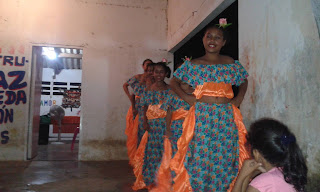 |
| Not only did we learn about the Seed program, but we got to experience a taste of MCC's work with partners in Colombia as well. Sembrando Paz works with rural communities wanting to rebuild their lives and culture after years of war and violence. We were greeted by a lovely group of girls doing a traditional dance. |
 |
| Unexpected encounters! Several years ago my grandmother Irma Penner visited Colombia as a part of a Mennonite sister church program. I was the great joy of meeting up with pastor Ricardo and his family which I was in Colombia. |
The gardens WENT
During the three weeks I was away in the US and Colombia,
cows came in and completely destroyed the fields where my students were
working. Life is tough here, and you can’t blame it all on poverty, climate, and
corruption. These cows belong to people, and people let them wander freely and
jump in other people’s fenced gardens during the night. Why don’t people keep
their cows somewhere else? There are laws to this effect, but they are rarely, if
ever enforced. The problem is extreme this year because so little rain meant that normal pasture land in the bush has long since dried up, and the gardens are the only edible thing in sight for miles around. Goats also got into our garden behind the church that I’d been
working with Amelia, the pastor’s wife. All that was left when I got back were
onions and some carrots. At least I can afford to buy replacement tomatoes,
kale, cabbage, and lettuce when they are available in the market. But most people in Machanga will not eat another vegetable until February after it rains.
 |
| Grace in my students' garden in July- beautiful growth! |
 |
| The exact same garden not three weeks later. |
 |
| The last of our carrot harvest. we had been taking them out of the ground as we wanted to eat, but goats became so desperate they started digging and chomping the tops off all the carrots, as you can see in the picture above. |
My two year
anniversary in Mozambique CAME and WENT last Thursday
Over two years in Mozambique gone and less than two months left.
 |
| When's the last time you washed all your shoes? This is one of the many habits I've picked up during my two years in Mozambique. |
I’M COMING HOME IN DECEMBER
Saving the
best news for last. Yes, I have signed myself up for another two and a half
years of this craziness with MCC, but I AM coming home for a month over Christmas.
I will see you all mid-December!